CRAFT

CRAFT
verb: to make or produce with care, skill, or ingenuity

Tuesday, January 16, 2018

Challenges

We all face them from time to time. Sometimes they're welcomed; other times, not so much.

One kind of challenge I welcome is an art group challenge.  It can give direction, boundaries; helpful when the options are vast.

I recently participated in a pouring group challenge:  create a piece, using any acrylic pouring technique, but using only blacks and whites.

First I tried out a technique using string dipped in paint and pulled across wet paint.  A lot of fun. 
Some of the details are so pretty.

Next, a dirty flip cup.  It went mostly grey but I got a gazillion cells. Go ahead, count 'em.
And last, but not least, a puddle pour. Oh the drama!
I'm still amazed at the variety achieved, even when using the same materials.  

Speaking of challenges, this post started out with a different idea but because I find keeping my focus and staying on topic a challenge, it went a different direction.  No worries!  Come back for my next entry when I get back on track.  Hint: one of the paintings above got a makeover.


Wednesday, January 3, 2018

Test, test, this is a ...

I love it when a simple test swatch produces such fun results. I was just testing some custom mixes for a black and white challenge. I dribbled some of each on a 4 inch square of paper. After a little swiping and swirling, I ended up with this:

I usually take few pictures of the results, just in case. And I'm often rewarded. This time I didn't see it at first. Really.  But once I did, I couldn't not. 


So, I just had to play with it 😉 in Autodesk. 


If only it wasn't the size of a postage stamp!


Saturday, December 23, 2017

It Came Upon a Midnight Clear is a very familiar carol. Most of us can probably sing the first verse from memory, and maybe the second and last. However, the third and fourth often get passed over. 

This arrangement by Robert Rice, as sung by The King's Singers, not only includes the middle stanzas, but even accentuates them. And because Rice has used a tune less familiar to me, I've been hearing it with fresh ears, so to speak. The fourth verse has been especially meaningful to me this year. The last few years have felt like a "weary road."  This carol helps us remember/gives us permission, to rest, listen, and hope!

It came upon the midnight clear,
That glorious song of old,
From angels bending near the earth,
To touch their harps of gold:
"Peace on the earth, goodwill to men,
From heaven's all-gracious King."
The world in solemn stillness lay,
To hear the angels sing.
Still through the cloven skies they come,
With peaceful wings unfurled,
And still their heavenly music floats
O'er all the weary world;
Above its sad and lowly plains,
They bend on hovering wing,
And ever o'er its babel sounds
The blessed angels sing.
Yet with the woes of sin and strife
The world has suffered long;
Beneath the angel-strain have rolled
Two thousand years of wrong;
And man, at war with man, hears not
The love-song which they bring;
O hush the noise, ye men of strife,
And hear the angels sing.
And ye, beneath life's crushing load,
Whose forms are bending low,
Who toil along the climbing way
With painful steps and slow,
Look now! for glad and golden hours
come swiftly on the wing.
O rest beside the weary road,
And hear the angels sing!
For lo!, the days are hastening on,
By prophet bards foretold,
When with the ever-circling years
Comes round the age of gold
When peace shall over all the earth
Its ancient splendors fling,
And the whole world give back the song
Which now the angels sing.
To listen click: https://youtu.be/ftiff8AjREQ

Thursday, December 14, 2017

I'd like to share with you an old recording of I Heard the Bells on Christmas Day.  It's an arrangement by Ovid Young and sung by Dean Wilder.

Now, I know it may not be in a style that many will find to their liking, but this is my favorite arrangement of Longfellow's poem. Let me tell you why. 

I admire the ability to hear how two different tunes can be combined into one song.  And Young did this beautifully. He begins and ends with the tune by John Baptiste Calkin, first used in 1872.  The middle section uses the tune written by Johnny Marks in 1956.

The two familiar tunes transition naturally from one to the other, and in so doing, perfectly capture the emotions of the words.  Words of sadness, discouragement, and yet, hope!

I'm also fascinated by the collaboration of four individuals, over the span of more than 100 years, each one separately contributing to the final work.

As I said, this is old - 1976!  So the quality isn't the best.  But I hope you'll take a quiet minute to listen.

Saturday, December 2, 2017

Greetings and Salutations


And thank-yous and thinking-of-yous.
I made cards!

My supplies:
Plain notecards, gel medium, sharpies and gel pen.

My pallet:
Little snippets of paint skins.

My process:
 I started by selecting coordinating pieces in varied sizes and adhered them to the card stock with gel medium.

Next came the doodling:
 sometimes penciling in ideas first, 
sometimes getting a little help from Autodesk Sketchbook.
e-sketch

Finally, it was time to commit and pick up the permanent markers.
Most were flowers.  Some had borders.


And then some mushrooms sprouted!


Tuesday, November 7, 2017

Finished Before I'm Done?

To be honest, sometimes I feel that way about life.  I would imagine everyone feels that way once in a while.  However, that's a little too deep and serious and not really the direction I was going with this post.  

I was thinking more along the lines of how do you know when an art piece is done.  I mean, you can't just stick a fork in it!  Well, of course, you can if that's the look you're going for.  But you know what I mean!

I've debated this question with just about every piece I've ever done.  It seems there's always more that can be added, tweaking that can be done. But how does one know when to quit?  

Good question!

This is just the beginning, so obviously, not yet.

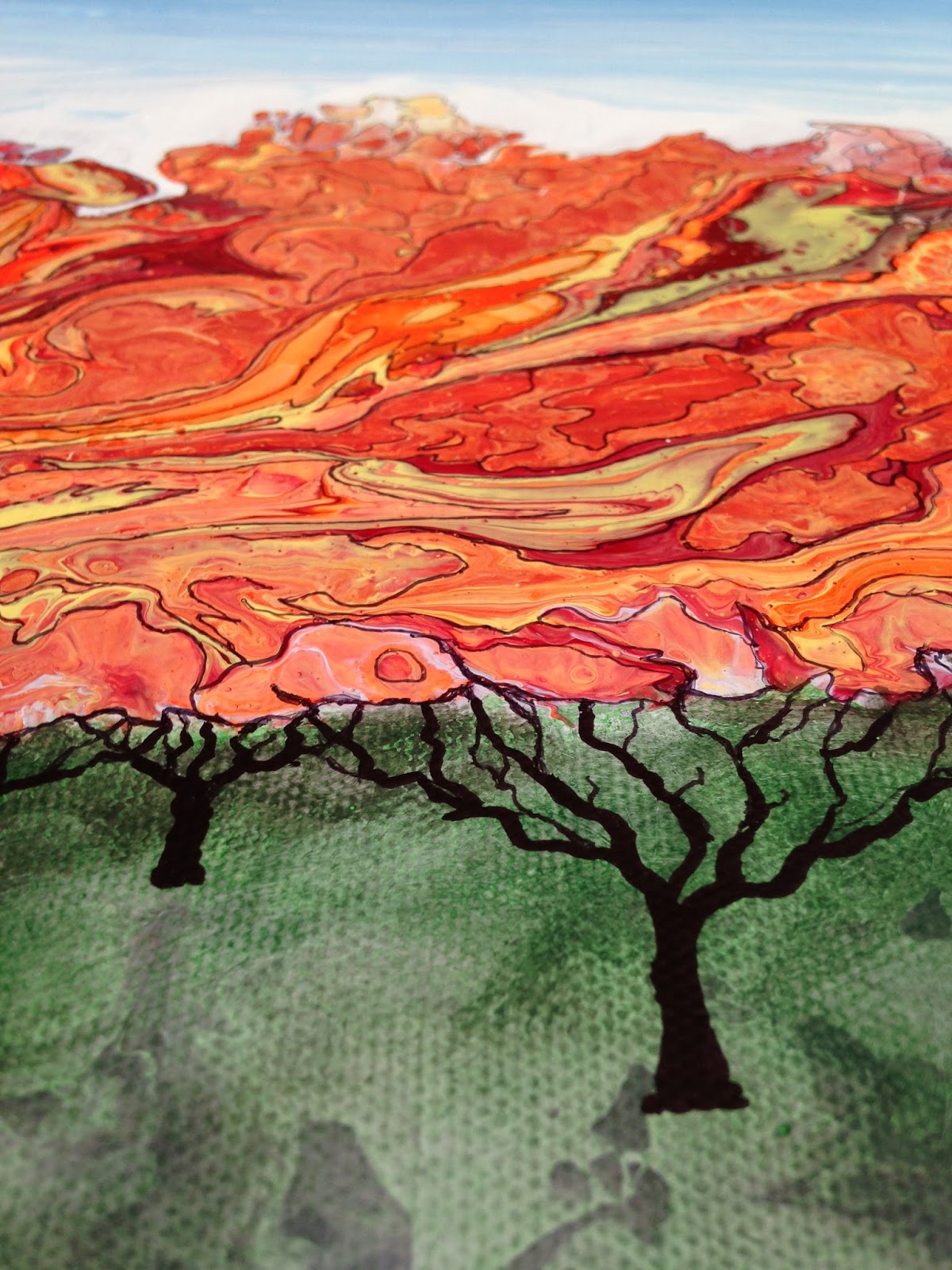
The sky and ground were poured on and moved around with my hand.  The middle is a mix of orange yellow and red dirty poured into puddles.

A little tipping and tilting to spread the puddles and a little blowing with a straw to mess up the straight edges.  Now, at this point, I suppose I could have called this Autumn Abstract and been done with it but that wasn't the look I was going for.

The grass is always greener if you paint it that color!  You may be asking why I didn't use green in the first place, instead of purple.  I was playing around with the idea of dappled shadows under the trees, knowing that I'd probably do a green wash over it.

After playing with some ideas in Autodesk I used a sharpie to doodle on the leaves and create the trunks and branches. I also used a white gel pen on the sky.


At this point, I was considering it done and it could have been.  But every time I looked at it it seemed something was missing.
So I did what usually do: I asked someone else to tell me what to do.  Well, not exactly.  But I did ask my daughter to offer her opinion.  Sometimes having fresh eyes look at what you've been staring at can help.
Is it done?  It could be.
Am I finished? Maybe.

The Tale of Two Paint Skins

Raise your hand if you've never heard of The Three Princes of Serendip. 
Me either! 
Or am I the only one?  Since I can't see how many hands were raised, I'm going to assume I'm not alone.

According to my sources (my children and their cousins), this ancient Persian tale is not common knowledge these days.  However, back in 1754, it must have been because Horace Walpole, in a letter to Horace Mann, coined the word serendipity to describe "discovery by accidental sagacity".  Now, if you're interested in words and their origins and meanings, it's a fascinating trip down the rabbit hole.

However, the point of this post is to share a little bit of serendipity that happened here.  Serendipity in the most common usage these days: a happy accident.

Take two paint skins, created on separate occasions.  One with an accidental drip (which did not make me happy).  No plans, just playing with paints.


Put them together and we have:


Mount Serendip